

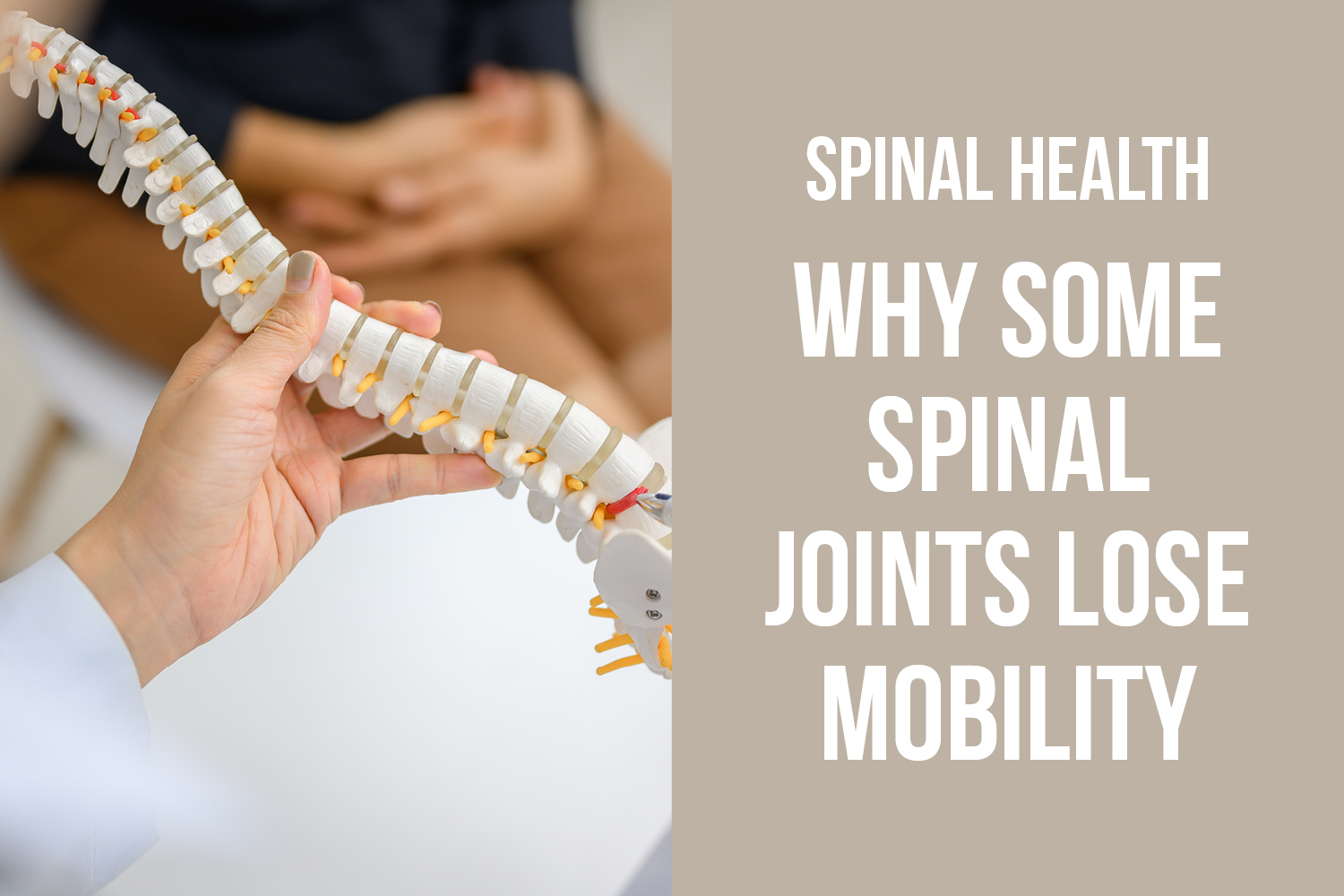
Your spine is not a single rigid structure but a chain of small joints working together to guide movement, distribute force, and support you throughout the day.
Even minor changes in how these joints move can develop gradually, often without obvious discomfort.
In chiropractic care, we focus closely on movement quality, not simply whether something hurts. How well a joint moves influences how efficiently your body adapts to daily demands.
Each level of the spine acts as a coordinated unit. Two neighbouring vertebrae, the disc between them, and the paired facet joints behind them work together to allow controlled motion. Ligaments provide restraint, while surrounding muscles offer stability and fine control.
The disc helps absorb compression and permits gentle movement between vertebrae. The facet joints guide direction, keeping motion smooth and contained. Muscles adjust their tone to support posture and activity, then ease once the task is complete.
When one part of this unit stiffens or becomes less responsive, the whole segment can behave differently. Nearby tissues may compensate, subtly altering how movement is shared.
Segmental dysfunction describes a spinal unit that does not move with its usual freedom or timing. It does not mean a bone is out of place. Instead, it refers to restricted glide, reduced elasticity, or altered coordination within the joint.
Healthy joints possess a small amount of natural give known as joint play. This spring-like movement reflects balanced capsule tension and good mechanical function. When joint play reduces, movement may feel firmer or less fluid.
End feel describes the resistance sensed at the end of motion. In a well-functioning joint, this resistance is smooth and elastic. In a restricted segment, it may feel earlier or slightly braced. Timing may also change, with one side initiating or completing movement unevenly.
These differences are often subtle, but they matter.
Restrictions typically build gradually. Sustained positions, repetitive tasks, and cumulative minor stresses can influence how tissues behave. Over time, muscles and connective tissues may adapt by becoming slightly less responsive or operating within a narrower range.
This is sometimes described as cumulative microtrauma, the result of repeated small demands rather than a single event.
You may only notice the effect when asking more of your body, such as turning sharply, reaching overhead, or moving after sitting for some time.
When a joint moves less freely, nearby muscles often increase their resting tone. This is a protective mechanism intended to provide stability. It may create a sensation of stiffness or reluctance to move, especially after inactivity.
The joint capsule also relies on regular motion to maintain healthy fluid exchange. Synovial fluid nourishes cartilage and supports smooth articulation. Reduced glide can slow this process, affecting how the joint feels under load.
Importantly, these patterns do not necessarily indicate damage. They usually reflect altered mechanics and protective responses that can be addressed.
Because the spine functions as a connected chain, one segment may compensate for another. An area moving less can lead a neighbouring level to move slightly more.
Assessment aims to identify where mobility is reduced and where motion remains balanced. Not every stiff area requires intervention, and not every sensitive area is the source of altered function.
By focusing on individual segments, chiropractors can support more precise and considered care.
The goal of chiropractic care is to restore appropriate motion where it has diminished. Targeted adjustments use controlled force to encourage improved joint glide and mechanical efficiency.
When mobility improves, surrounding muscles often settle naturally. As movement becomes smoother, joint surfaces can interact more comfortably, and local coordination can improve.
Clear movement also provides more consistent sensory feedback to the nervous system, supporting steady, efficient motion.
Segmental dysfunction represents a shift in movement quality, not necessarily injury. Addressing these subtle restrictions can help the spine distribute forces more evenly and respond more smoothly to daily activity.
When spinal joints move well together, the body operates with less unnecessary strain. That quiet efficiency supports comfortable, resilient movement throughout everyday life.

contact@wealdchiropractic.co.uk
Unit 29 Graylands Estate, Langhurst Wood Road, Horsham, West Sussex RH12 4QD
Website design by theshapingbay.com