

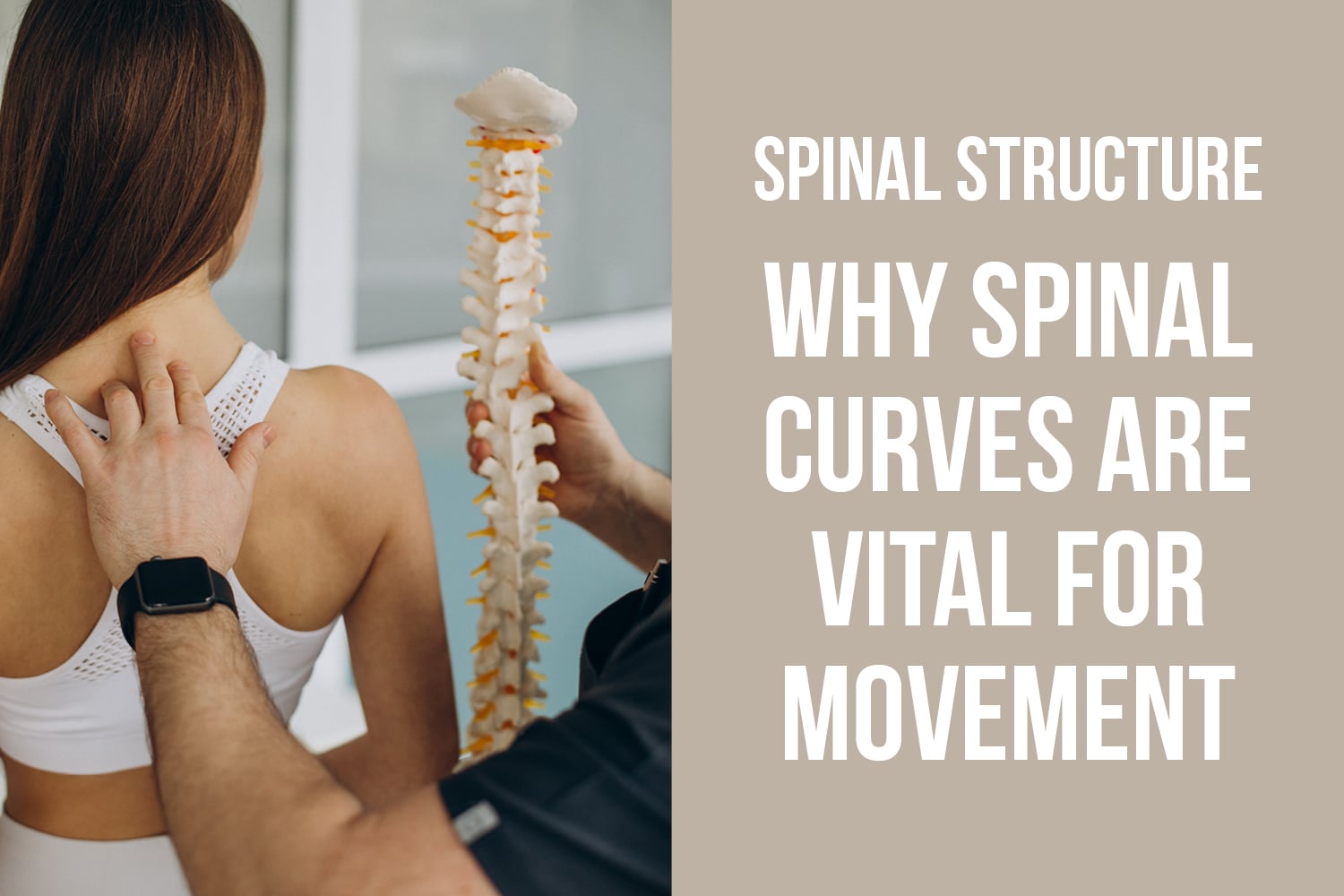
At first glance, your spine might appear relatively straight. In reality, it’s shaped by a series of gentle curves that help your body manage weight, movement, and gravity. They are deliberate structural features that allow the spine to function efficiently under everyday demands.
Thanks to these curves, the spine behaves more like a spring. They allow it to absorb force, distribute load, and remain both strong and flexible. When they’re well balanced, movement tends to feel easier and more coordinated.
Chiropractic care focuses on supporting the spine so these natural curves can function as they’re designed to
The spine has three primary curves.
This alternating pattern creates an S-shaped design. Each curve helps position the head and trunk over the pelvis, supporting upright posture without excessive muscular effort.
These curves also help the spine adapt to different tasks. When you walk, lift, or turn, forces travel through these natural arcs. The shape allows those forces to be redirected and shared rather than concentrated in one place.
One of the most important roles of spinal curvature is shock absorption. Every step you take creates ground reaction forces that travel upward through the body. The curved structure helps soften and disperse that impact.
A straight column would transmit force more directly. A curved structure, however, can flex slightly under load and then return toward its resting shape. This spring-like behaviour reduces strain on discs, joints, and supporting tissues.
This doesn’t mean the spine moves dramatically with each step. Rather, the changes are small and controlled. But when you consider it repeats these changes thousands of times each day, you can see how this subtle adaptability makes a meaningful difference.
Spinal curves influence how weight is shared across discs and facet joints. In a balanced spine, compressive forces are distributed in a way that suits the shape of each region.
The lumbar curve helps position the upper body over the pelvis, allowing weight to pass efficiently through the vertebrae. The thoracic curve provides space for the rib cage and supports rotational movement. The cervical curve helps balance the head, which is heavier than many people realise.
When curvature changes over time, force distribution can shift. Some regions may experience increased compression, while others contribute less effectively. These changes are often gradual and reflect adaptation rather than sudden injury.
Spinal curves are not fixed from birth. They develop during early movement milestones and continue to adapt throughout life. Growth, occupation, habitual positions, and previous injuries can all influence their shape.
A reduction or exaggeration of a curve alters how forces travel through the spine. Muscles may need to work slightly harder to maintain balance. Certain joints may carry more demand than others.
These changes are usually subtle. Many people function well despite mild variations in curvature. The key consideration is not achieving a textbook shape, but supporting efficient load transfer and coordinated movement.
The body is designed to conserve energy wherever possible. When spinal curves are balanced, less muscular effort is required to maintain upright posture. Weight passes through the skeletal framework in a steady and economical way.
If curvature becomes less balanced, the body can compensate. Muscles may increase their activity to stabilise certain regions. Over time, this can influence how easily movement feels, particularly during prolonged standing or sustained activity.
Efficiency in this context refers to how smoothly structure and muscle support work together. The curves form the architectural foundation for that cooperation.
Chiropractic assessment considers how spinal segments contribute to overall alignment and movement. While curves themselves are structural features, joint mobility within those curves also matters.
Supporting balanced movement at individual segments may help the spine function more evenly as a whole. The goal is not to force a particular shape, but to encourage coordinated mechanics within the framework the body has developed.
When natural curves are supported by healthy joint motion and appropriate muscle activity, the spine can manage daily forces with less unnecessary strain.
Your spinal curves are part of an intelligent structural design. They allow strength and flexibility to coexist. By understanding their role, it becomes clearer how structure and movement work together to support efficient, resilient function throughout everyday life.

contact@wealdchiropractic.co.uk
Unit 29 Graylands Estate, Langhurst Wood Road, Horsham, West Sussex RH12 4QD
Website design by theshapingbay.com